 Image 1 of 1
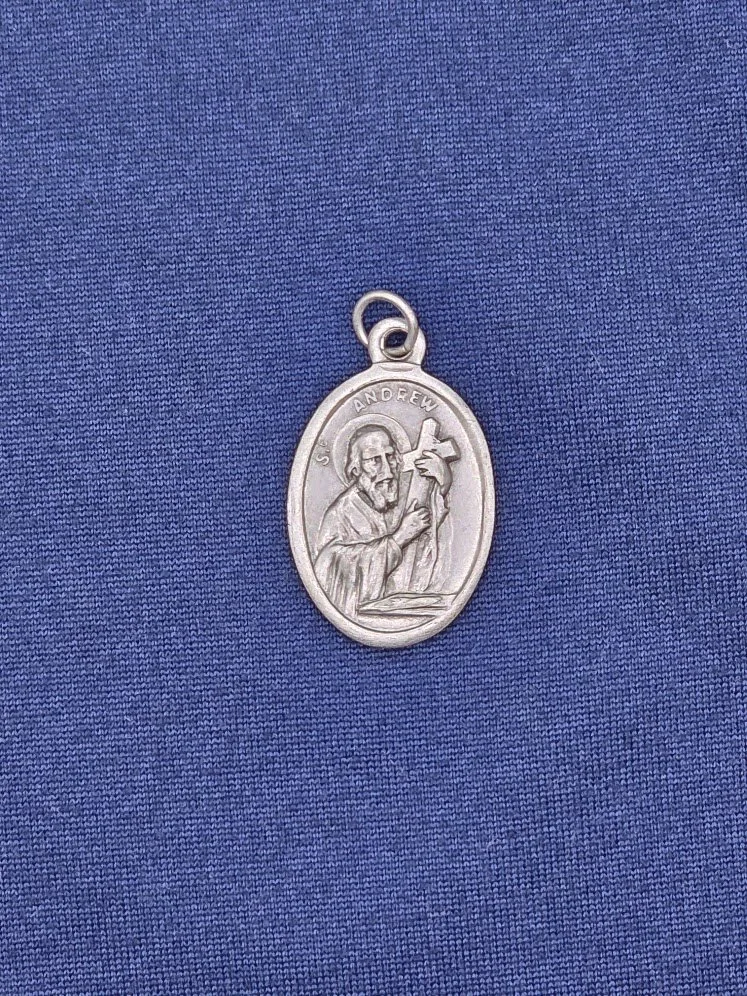
Saint Andrew (also known as Saint Andrew the Apostle or Andrew the First-Called) was one of the Twelve Apostles of Jesus Christ. He was a fisherman from Bethsaida in Galilee and the older brother of Saint Peter. According to the Gospels, Andrew was originally a disciple of John the Baptist. He was the first apostle called by Jesus (hence “the First-Called” or Protocletus), and he immediately introduced his brother Peter to Jesus. He is mentioned in key events such as the multiplication of the loaves and fishes.
Tradition holds that after Jesus’ resurrection and ascension, Andrew preached the Gospel in regions around the Black Sea, in Greece, and possibly Scythia (modern Ukraine/Russia area). He was martyred around 60–70 AD in Patras, Greece, by crucifixion on an X-shaped cross (now known as the Saltire or St. Andrew’s Cross), which he requested because he felt unworthy to die on a cross like Christ’s. His feast day is celebrated on November 30.
Saint Andrew is widely venerated as the patron saint of:
Scotland (his flag, the white Saltire on blue, forms part of the Union Jack)
Russia, Ukraine, Romania, and Greece
Fishermen and fishmongers (reflecting his original profession)
Singers (in some traditions)
He is also patron of several other countries, cities (including Patras, Amalfi, and Barbados), and groups such as gout sufferers, rope makers, textile workers, and maidens/spinsters seeking husbands in certain folk traditions.
His symbol is the X-shaped cross, and he is often depicted holding a fishing net or the diagonal cross. Devotion to him remains especially strong in Scotland (St. Andrew’s Day on November 30 is a national holiday) and Eastern Europe.
Saint Andrew (also known as Saint Andrew the Apostle or Andrew the First-Called) was one of the Twelve Apostles of Jesus Christ. He was a fisherman from Bethsaida in Galilee and the older brother of Saint Peter. According to the Gospels, Andrew was originally a disciple of John the Baptist. He was the first apostle called by Jesus (hence “the First-Called” or Protocletus), and he immediately introduced his brother Peter to Jesus. He is mentioned in key events such as the multiplication of the loaves and fishes.
Tradition holds that after Jesus’ resurrection and ascension, Andrew preached the Gospel in regions around the Black Sea, in Greece, and possibly Scythia (modern Ukraine/Russia area). He was martyred around 60–70 AD in Patras, Greece, by crucifixion on an X-shaped cross (now known as the Saltire or St. Andrew’s Cross), which he requested because he felt unworthy to die on a cross like Christ’s. His feast day is celebrated on November 30.
Saint Andrew is widely venerated as the patron saint of:
Scotland (his flag, the white Saltire on blue, forms part of the Union Jack)
Russia, Ukraine, Romania, and Greece
Fishermen and fishmongers (reflecting his original profession)
Singers (in some traditions)
He is also patron of several other countries, cities (including Patras, Amalfi, and Barbados), and groups such as gout sufferers, rope makers, textile workers, and maidens/spinsters seeking husbands in certain folk traditions.
His symbol is the X-shaped cross, and he is often depicted holding a fishing net or the diagonal cross. Devotion to him remains especially strong in Scotland (St. Andrew’s Day on November 30 is a national holiday) and Eastern Europe.